Home / Waterfalls / Harajiri Falls
Harajiri Falls 原尻の滝
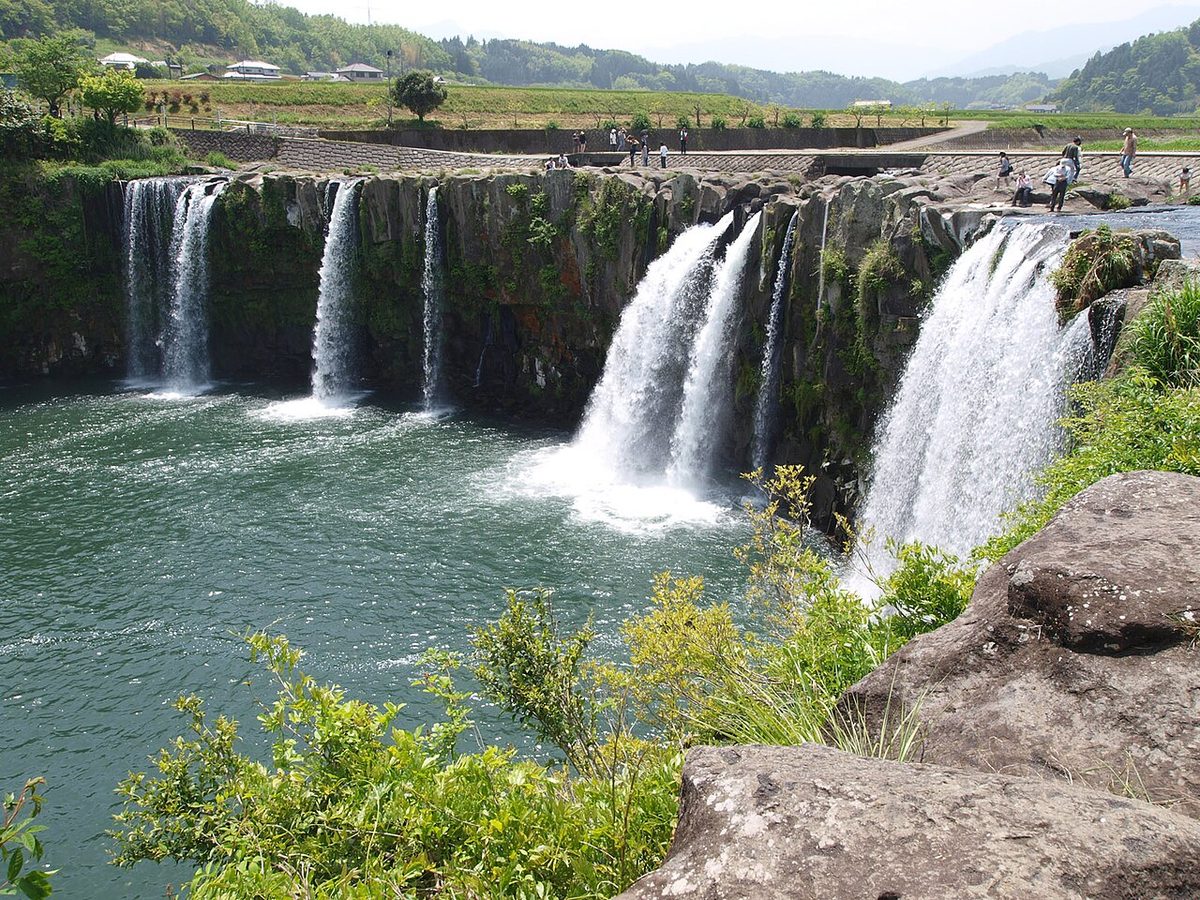

| Drop | 20 m (66 ft) |
|---|---|
| Width | 120 m (394 ft) |
| Location | Bungo-ōno-shi, Oita, Japan |
| Region | Kyushu |
| Selected Waterfalls list | No. 91 of the 100 Selected Waterfalls of Japan (Nihon no Taki Hyakusen, 1990) |
| Coordinates | 32.96389° N, 131.45111° E |
Characteristics
120 meters wide and 20 meters high. It is characterized by waterfalls that appear on the plains surrounded by countryside, and sometimes it is called "Niagara of the East." The waterfall is made of aso-4 molten limestone falling down, and you can see a column on the cliff. After the pyre that filled the valley when Akeyama erupted some 90,000 years ago, water began to flow again and was formed by erosion. The nearby Falls of Descending is the same formation process. At the bottom of the waterfall, there is a wooden suspension bridge, and at the very top, there are two subsoil bridges, and the walkways that go around these bridges are built around them. You can also go down to the edge of the waterfall or take a boat trip around the falls.
The perimeter
On the left side of the waterfall is the road station Harajiri Falls, which is available when you tour the waterfall. In the 500 meters upstream of the falls, there is a five-breast bridge built in 1923. The rice fields around Harajiri Falls have about 500,000 tulips planted during the restructuring season, and in April of the blooming season, they will host the cypress Tulip Festa. In addition, during the event, car access to the waterfall will be limited.
An accident
A lady who was on a tour of the concert went into a waterfall and died. On August 24th, 2009 (pronounced 21, 2009) a car ran from a city road passing by a waterfall and fell into a waterfall and killed two people. On July 13, 2025) A 19-year-old Korean male student fell out of the waterfall and disappeared at night, and the search after the next day found her body in a waterfall.
Traffic
The stop stop is from Japan's Kota Tokuta Bus heading towards Tokita.
Text adapted from the Japanese Wikipedia article 原尻の滝, whose full text was translated into English for this guide by its contributors, licensed CC BY-SA 4.0. Drop and location facts cross-checked with Wikidata (CC0) and the 100 Selected Waterfalls of Japan list (Japanese Wikipedia, CC BY-SA 4.0).